
From prehistoric times to 19th century
Over the past years we have grown used to consumer electronics companies introducing wave after wave of new smart devices and services that augment or replace our physical environment in a digital way. The idea of virtual and augmented reality is however nothing new and it is worth while to go back in time to see how our ancestors surrounded themselves in immersive spaces and used the technology that was available at their time. We see that the idea of escaping reality is as old as humanity itself.
We start our journey around 65,000 years ago in Australia. Central in Aborignals culture and religion is the notion of Dreamtime. Land, lakes, rivers, streams, hills, rocks, mountains, trees, plants, flowers, animals – everything is created by the Ancestors who walked the Earth in the Beginning, singing out the names of everything that crossed their paths and in doing so they sang the world into existence. The Ancestors also gave the Aboriginals their hunting tools and each tribe their land and sacred places to protect. In the Aboriginal worldview, every meaningful activity, every event that occurs at a particular place leaves a vibration in the earth that echoes the events that brought that place into existence. The Aboriginals view themselves as the preservers of the invisible pathways or songlines that define Australia and take great care not to disrupt these pathways by their actions. See for example The Songlines: Chatwin, Bruce: 9780140094299: Amazon.com: Books. Dreaming stories vary throughout Australia with variations on the same theme, for example the story of how the Sun was made is different in New South Wales than in Western Australia. These songlines, stories in nature itself, augment the reality of the Aboriginals and give meaning and purpose. And they did not need smartphones…
We move to Europe and fast forward in time some 40,000 years to France under the ground in the Caves of Lascaux (culture.gouv.fr). Anthropologists and art historians theorize that the paintings on the walls of the caves that contain animals, human figures and abstract signs are the accounts of past hunting success stories or the mystical rituals to improve future hunting endavors. Here in the prehistoric caves and their wall paintings, that were rediscovered in 1940, people created an alternate reality that blended the natural, external world outside with their mystical, internal world.
Wall paintings from the late Roman Republic reveal examples of illusionary spaces that make the wall surface extend beyond the single plane, making the room appear larger in size and drawing the visitor into the painting (see also Oliver Grau’s book on Virtual Art (mit.edu) from illusion to immersion for more examples). One of the best kept examples are the frescos in the Villa dei Misteri in Pompeii (60 B.C), one of Pompeii most visited tourist destinations, who immerse visitors in what is thought of as the initiation of a young woman to a Greco-Roman mystery cult.
Around the same time, Julius Caesar rose to become one the most powerful politicians in the Roman Republic through a number of large victories in Gaul that led to the Roman Empire. Caesar not only waged wars but also brought spectacles to Rome of historic battles on land and sea. The Naumachia Rome: Ancient Simulated Sea Battles in Colosseum (visit-colosseum-rome.com) were mocked naval battles with hundreds sometimes thousands of actors that played out in front of large audiences. The first such naval battle was in a man-made lake built in the Campus Martius filled with water from the Tiber River. Roman historian Seutonius, writes in the first century A.D, that people from all over Italy attended to see two fleets of biremes, triremes and quadriremes with 4,000 galley slaves and 2,000 crew members on board clashed in a full-scale reconstruction of a naval battle in the Campius Martius. Perhaps even the Colloseum was used to stage Naumachia: historians believe Emperor Titus flooded the Colloseum with enough water for ships to sail using the canals, tunnels and storage rooms in the colloseum The Story Behind Ancient Rome’s Bloody Mock Naval Battles, or Naumachia (nationalgeographic.com)
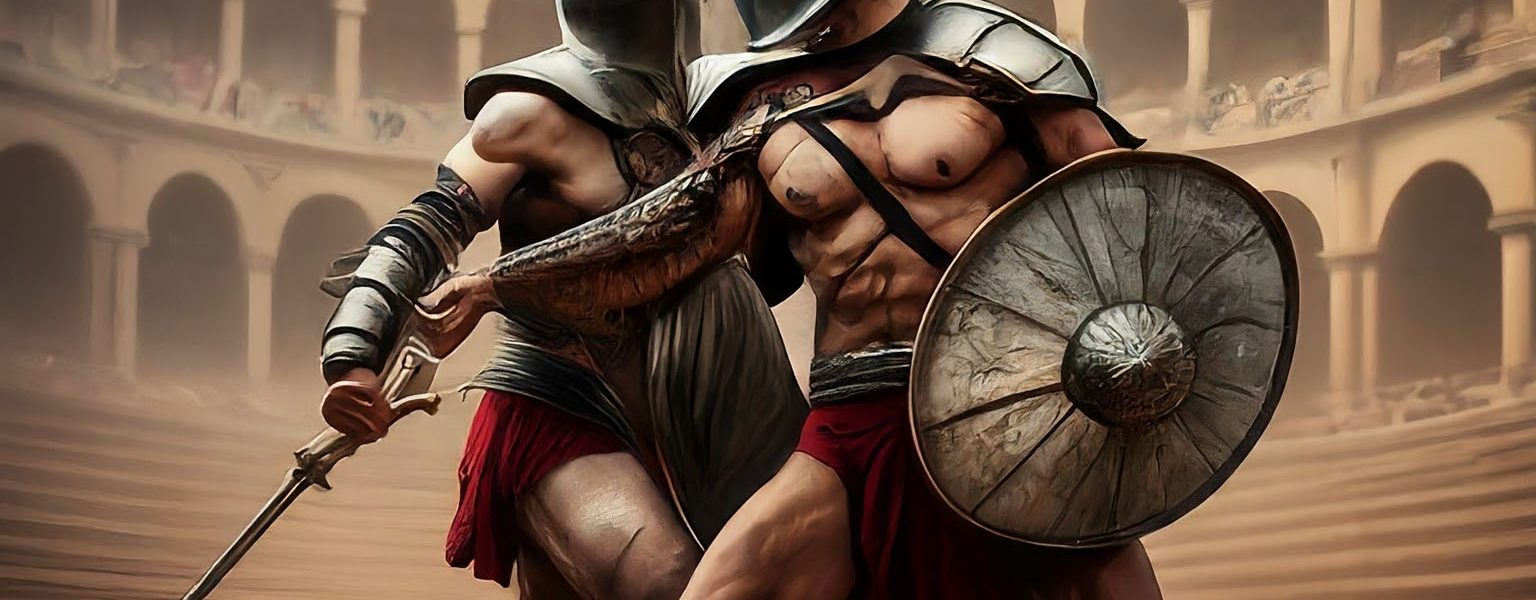
Today, in themepark Puy du Fou in France, visitors can still experience a glimpse of these Roman gladiator fights, with no casualities, in a show with actors in a replica of an amphitheater. Le Signe du Triomphe – Gallo-Roman Show | Shows – Shows Puy du Fou
For centuries religions have employed architecture to induce spirtual experiences or represent the glory of their god. This can be seen in the use of stained glass in churches to flood a church’s interior with colored light and create a sense of being touched by the divine. Walls and ceilings of spiritual places have also long been decorated with paintings, carvings, statutes that depict the important events and stories in the sacred texts for the largely illiterate population. One of the best known examples is the ceiling in the Sistine chapel in the Apostolic Palace, the official residence of the pope in Vatican City. When the Sistine chapel was built between 1473 and 1481 the original ceiling was azure blue and decorated with golden stars. Pope Julius II contracted Michelangelo in 1508 to paint frescos on the Ceiling (museivaticani.va) of the Sistine chapel in a style that matched the significance of the chapel in Christianity. Michelangelo needed 4 years to complete the ceiling frescos that among others depict passages of the book of Genesis. In 1535 Michelangelo would be approached again to decorate the sanctuary wall with a scene from the Last Judgement. Both paintings are seen as masterpieces of high Renaissance art and show amazing mastery of combining real architecture and illusionary architecture.
The oldest blueprint of the magic latern is described by Dutch scientist and inventor Christian Huygens around 1654. The Laterna Magica Magic lantern – Wikipedia is a device that is a precursor to the slide projector, it consists of a hollow mirror in the back, a lens in the front and a light source in the middel. In front of the lens a small piece of glass with transparent painting is placed that that is projected on a large screen. The magic latern enabled projections of imagery on walls, ceilings and arguably one of the first uses of technology to augmented reality.
In the late 18th Century several showmen used the lantern to produce horror shows. These were known as ‘Phantasmagoria’ shows. A variety of horrific images were projected to frighten the audience, examples being ghosts projected on smoke to give a frightening appearance. Mobile magic laterns would be used that could be changed position during the play to create the illusion of moving objects through space. For more details see A history of the Magic Lantern – The Magic Lantern Society.
Around the same time, in the late 18th century, English painter Robert Barker invented a new visual medium which enabled paintings to be shown on the inside of cylindrical surface and could be viewed by spectactors from the center of the cylinder surface so that they could see the entire 360 degree horizon. Europe’s biggest “panorama” dates back to 1881 and was created by Dutch painter Hendrik Willem Mesdag. Panorama of Scheveningen – Europe’s biggest ‘circular’ painting – Holland.com can still be seen today in the museum which shares his name (Museum Panorama Mesdag) in The Hague and is 120 meters long and 14 meters high, the diameter is nearly 40 meters. It depicts the sea, beach and dunes of the North Sea and life in late 19th century Scheveningen and still gives visitors a sense of presence.
In the 19th century the world would also witness the first virtual reality device in the stereoscope invented by Sir Charles Charles Wheatstone – Wikipedia. Instead of placing projections, paintings on walls, ceilings and screens and placing the spectator in the center, the stereoscope brought the imagery close to the eyes of the observer, presenting each eye with a slightly different picture to create a 3D effect. Charles Weatstone was awarded the Royal Medal of the Royal Society in 1840 for his explanation of binocular vision, and this research led him to make stereoscopic drawings and construct the stereoscope.